
The United States will use additional legal defenses to keep as many of Trump’s tariffs in place as possible, according to Treasury Secretary Scott Bessent and other administration officials.
WASHINGTON (Reuters) — The US Supreme Court overturned President Donald Trump’s broad tariffs, which he sought under a statute intended for use in national emergencies, rejecting one of his most disputed assertions of authority in a decision with far-reaching consequences for the global economy.
In a 6-3 decision, the justices maintained a lower court’s determination that the Republican president’s use of the 1977 statute went beyond his power. The Supreme Court made its decision in a court challenge brought by firms harmed by the tariffs and 12 US states, the most of which are Democratic-led, against Trump’s unprecedented use of this statute to unilaterally impose import levies.
Trump has used tariffs, or levies on imported products, as a crucial economic and foreign policy instrument.
They have played a significant role in Trump’s global trade war, which has alienated trading partners, impacted financial markets, and produced global economic uncertainty since his second term began.
Trump’s tariffs were expected to raise trillions of dollars in income over the next decade for the United States, which has the world’s largest economy.
The Trump administration has not disclosed tariff collecting statistics since December 14.
However, analysts at Penn-Wharton Budget Model calculated on Friday that the sum collected from Trump’s tariffs under the International Emergency Economic Powers Act was more than $175 billion. If the Supreme Court rules against the IEEPA-based tariffs, that sum will most likely have to be repaid.
The United States Constitution gives Congress, not the president, the right to levy taxes and customs. Instead, Trump used legislative power, using IEEPA, to put tariffs on practically every US trade partner without congressional permission.
Trump has imposed additional tariffs under legislation different than those at issue in this lawsuit. According to official data from October to mid-December, this accounts for almost one-third of the revenue from Trump’s tariffs.
IEEPA allows the president to regulate commerce during a national emergency. Trump became the first president to impose tariffs under IEEPA, one of many ways he has aggressively pushed the boundaries of executive authority since taking office, including his crackdown on immigration, the firing of federal agency officials, domestic military deployments, and military operations abroad.
Trump presented the tariffs as critical to US economic security, claiming that the country would be unprotected and devastated without them.
In November, Trump told reporters that without his tariffs, “the rest of the world would laugh at us because they’ve used tariffs against us for years and took advantage of us”.
Trump said that other countries, notably China, the world’s second largest economy, had mistreated the United States.
After the Supreme Court heard arguments in the case in November, Trump told reporters that if it ruled against him on tariffs, “we’ll have to develop a ‘game two’ plan”.
Treasury Secretary Scott Bessent and other administration officials stated that the United States will use alternative legal arguments to maintain as many of Trump’s tariffs as feasible.
Among these are a statutory provision that allows tariffs on imported goods that threaten US national security, as well as another that allows for retaliatory actions, such as tariffs against trading partners determined by the Office of the US Trade Representative to have engaged in unfair trade practices against American exporters.
None of these options gave Trump with the same flexibility and blunt-force dynamics as IEEPA did, and they may not be able to recreate the entire extent of his tariffs in a timely way.
Trump’s ability to put tariffs on any trading partner’s goods instantly under the guise of a declared national emergency increased his power over other countries.
It prompted international leaders to rush to Washington to negotiate trade agreements, which frequently included guarantees of billions of dollars in investments or other offers of improved market access for US corporations.
However, Trump’s use of tariffs as a tool in US foreign policy has successfully antagonized a number of countries, even those who were formerly considered close US friends.
IEEPA has generally been used to inflict sanctions on opponents or freeze their assets, rather than to levy tariffs. Tariffs are not directly mentioned in the statute.
Trump’s Justice Department contended that IEEPA enables tariffs by granting the president the authority to “regulate” imports in an emergency.
The Congressional Budget Office estimates that if all present tariffs remain in place, including IEEPA-based charges, they will collect approximately $300 billion per year over the next decade.
Total US net customs duty revenues reached a new high of $195 billion in fiscal 2025, which concluded on September 30, according to US Treasury Department figures.
On April 2, which Trump dubbed “Liberation Day,” the president announced what he called “reciprocal” tariffs on goods imported from the majority of US trading partners, invoking IEEPA to address what he called a national emergency related to US trade deficits, despite the fact that the US had been running trade deficits for decades.
In February and March 2025, Trump utilized IEEPA to impose tariffs on China, Canada, and Mexico, alleging the trafficking of the often misused opioid fentanyl and illegal substances into the United States as a national emergency.
Trump has used tariffs to obtain concessions and renegotiate trade agreements, as well as to penalize countries that he disagrees with on non-trade political issues. These have included Brazil’s prosecution of former President Jair Bolsonaro, India’s imports of Russian oil, which help support Russia’s conflict in Ukraine, and an anti-tariffs advertisement by Canada’s Ontario province.
Congress enacted the IEEPA, and Democratic President Jimmy Carter signed it. In approving the bill, Congress limited the president’s authority more than a previous statute.
The tariff issues before the court included three lawsuits.
The US Court of Appeals for the Federal Circuit, located in Washington, ruled in favor of five small firms who import items in one case and the states of Arizona, Colorado, Connecticut, Delaware, Illinois, Maine, Minnesota, Nevada, New Mexico, New York, Oregon, and Vermont in another.
Separately, a Washington-based federal judge ruled in favor of Learning Resources, a family-owned toy manufacturer.
Related posts:
 China strikes the US with 84 percent in retaliatory tariffs as the trade war worsens.
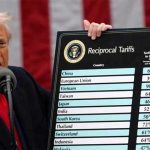 Pakistan is among the globe countries that face US tariffs.
 Another immigration-related gunshot causes havoc in Minneapolis.
 Zelensky says US deal is ‘correct measures’ and slams backing for Russian exporters
 Trump escalates the global trade battle by announcing massive import taxes.
 China issues risk advisory for travelers traveling to the US.
 President Trump extends an invitation to his Egyptian and Turkish counterparts to join the Gaza “Board of Peace.”
Trump administration considers travel restriction for dozens of nations, including Pakistan.
President Trump extends an invitation to his Egyptian and Turkish counterparts to join the Gaza “Board of Peace.”
Trump administration considers travel restriction for dozens of nations, including Pakistan.
 Trump says Greenland’maybe’ in the US future, as territorial leaders blast US delegation trip.
 A Russian TV reporter was murdered by a landmine near the Ukrainian border.
 Macron will meet with leaders of Egypt and Jordan to discuss Gaza.
 At least 12 people were murdered in Australia