
Pakistan has proposed Islamabad as a potential location for negotiations involving senior Trump administration and Iranian officials as early as this week, according to two people familiar with the conversations.
LONDON (Web Desk) — According to the British publication Financial Times, Tehran and US special envoys Steve Witkoff and Jared Kushner are having backchannel communications thanks to senior Pakistani officials.
The publication claims that Pakistan is leveraging Field Marshal Asim Munir’s connections to Tehran and cordial rapport with Donald Trump to position itself as the principal mediator attempting to mediate an end to the US and Israel’s war against Iran.
Pakistan has proposed Islamabad as a potential location for negotiations between Iran and top Trump administration officials as early as this week, according to two people with knowledge of the conversations.
According to two persons briefed on the conversation, Army Chief Asim talked with Trump on Sunday, and PM Shehbaz Sharif spoke with Iranian President Masoud Pezeshkian on Monday.
The discussion between the Iranian and Pakistani presidents coincided with Trump’s announcement that he was postponing his threat to “obliterate” Iran’s power facilities following “very good and productive” talks to end the conflict with Tehran.
It was unclear whether Trump’s tweet on his Truth Social social media site, which precipitated a steep decline in oil prices, and Pakistan’s mediation attempt were connected. Regarding Trump discussions, the White House declined to provide any details. The White House stated, “The United States will not negotiate through the news media because these are sensitive diplomatic discussions.”
In an effort to ensure a temporary truce and create room for talks, Turkey, which participated in pre-war mediation efforts, has also been speaking with Iranian officials and Trump’s envoy Steve Witkof. Muhammad Ishaq Dar, the foreign minister of Pakistan, met with Hakan Fidan, the foreign minister of Turkey, on Monday. Along with Witkoff and the foreign minister of Qatar, Egypt’s foreign minister Badr Abdelatty also had conversations with his colleagues in Iran and Pakistan on Sunday.
Iran’s foreign ministry stated that several regional powers were participating in mediation attempts but denied that there had been any direct talks with the US since the war began.
The foreign ministry’s spokeswoman, Esmaeil Baqaei, told the official news agency IRNA, “Over the past few days, messages were received via certain friendly states conveying the US request for negotiations to end the war.” “Appropriate responses [to those initiatives] were given in accordance with the country’s fundamental positions.”
According to IRNA, the spokesman maintained that Iran’s stances on the Strait of Hormuz situation and Tehran’s demands for the conclusion of the conflict had not changed.
As the conflict enters its fourth week, analysts and diplomats issued a warning about the likelihood that any mediations would be successful. The diplomatic attempts, according to those informed on the subject, entailed extremely early-stage communications rather than a formal procedure.
Sanam Vakil at the Chatham House think-tank, said several countries were “scrambling” to de-escalate the conflict but added: “I don’t take this as any signal the war is coming to an end.”
She went on to say that pressure from Gulf governments may persuade Trump to retract his warning. Iran promised to strike essential infrastructure throughout the area, such as electricity facilities and water desalination plants, in retaliation for any attack on its power plants.
In a Truth Social post on Saturday night, Trump threatened to attack Iran’s power stations, “starting with the biggest one,” if Tehran refused to permit ships to pass through the channel, which typically carries around a fifth of the world’s gas and oil.
Related posts:
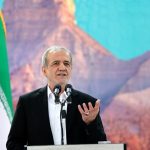 Iran is willing to resume nuclear discussions with the USA if confidence is established : President Pezeshkian.
 China strikes the US with 84 percent in retaliatory tariffs as the trade war worsens.
 China issues risk advisory for travelers traveling to the US.
 Iran is nearing an agreement with China to acquire supersonic anti-ship missiles.
 Qatar arrests 313 individuals for distributing assault footage and misinformation.
 Zelensky says US deal is ‘correct measures’ and slams backing for Russian exporters
 At least 144 killed as powerful quake rocks Myanmar and Thailand.
 With more than 2,700 people killed in the Myanmar earthquake, the lack of water and medication gets worse.
 Pakistan is among the globe countries that face US tariffs.
 US imposes additional sanctions on Iran as Trump seeks negotiations.
 Another immigration-related gunshot causes havoc in Minneapolis.
 Bangladesh’s BNP poised for’sweeping’ election victory.